

The Cardplayer
A deck of cards sat atop the wooden table

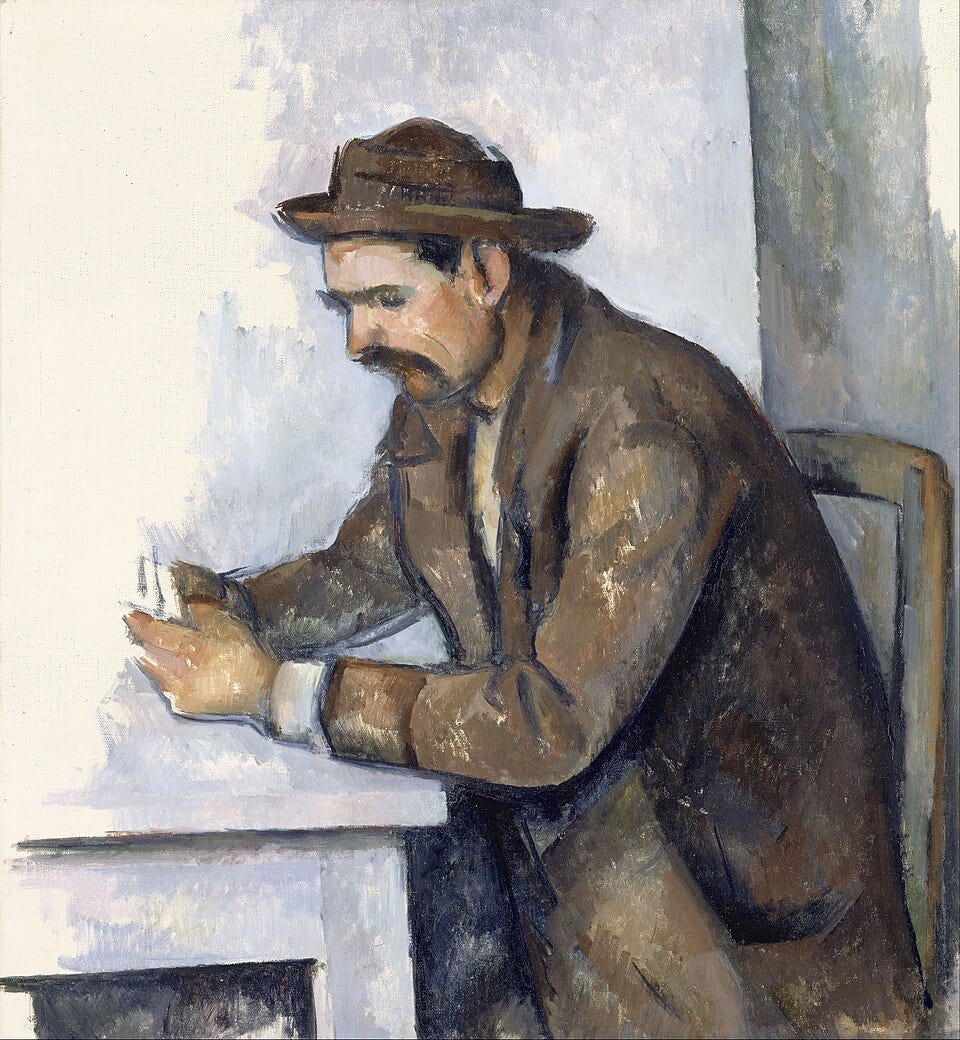
A deck of cards sat atop the wooden table, their colourful pictures a contrast to the faded and chipped tabletop. The backs of each were a mix of red and black shapes, and the fronts were white, overlaid with a red or black picture or series of shapes. Right now, four hearts sat atop the pile facing the ceiling, and The Cardplayer returned to his seat, setting his mug down and adding to the many overlapping rings which had already stained the wooden surface. Scooping the deck up with his spindly fingers, he turned them over and began to shuffle before setting the pile back down.
He picked the uppermost card and turned it over before quickly placing it alone on the tabletop. After, he followed suit with the subsequent cards, building multiple smaller piles according to the rules of his game, before drawing one and stopping all of a sudden. Whilst he leant back in his chair, The Cardplayer began to twirl his moustache around his index finger, and his forehead began to crease. Deep in thought, he stared at the cards for a minute, two, three… until he finally picked up the Jack and set it down on the farthest left-hand pile. The Cardplayer then took a sip from his mug and allowed himself a long, drawn-out exhale, before wiping his forehead with a handkerchief and then using both hands to push his cards into one pile and shuffle them yet again. Like Sisyphus watching his enchanted boulder roll back down the slope, The Cardplayer watched as his own hands shuffled his sorted cards and returned them to one disorganised pile. Before beginning another game, he pulled a pack of cigarettes from his pocket and slipped one out, bringing it to his lips and lighting it. Now with his trusty companion pursed between his lips, he once again flipped the pile of cards over and began his routine of separating them, pausing now and then to ponder the best path forward.
Out of nowhere, however, his attention was drawn away from his game: outside his window, a group of young men and women marched past, holding up signs and shouting. The Cardplayer glanced up, thinking about what he had read earlier about newly proposed workers’ rights reforms, and thought that from the snippets he heard through the window, they were likely protesting about those. His mind briefly considered the newspaper article which he had skimmed through on his morning commute, but it was quickly drawn back to the tabletop in front of him and the game waiting to be played.
As his hands played with the fifty-two cards on the tabletop, all creased and bent along the edges from repeated use, The Cardplayer was immersed in his own little world, without a care for anything outside his four walls. The anxieties and stresses of everyday life ceased to exist once he set his mind and hands to work, shuffling and sorting the cards this way and that. He played his little game again and again, each evening after he returned from work, finding solace in the solitude it brought him. In this brief hour or two, he immersed himself in blissful ignorance, sitting at his old wooden table, before his family returned home, and he would lay the cards aside, returning to the outside world.
One day, far away from the Cardplayer and even further from his control, a war broke out in some foreign country, and slowly but surely, the surrounding states were dragged in, some kicking and screaming in resistance, and some jumping at the prospect of making a quick profit off of others’ misfortunes. This conflict wreaked havoc on international relations and trade, and, as it always does, this trickled down to small towns and cities, increasing everyday prices and piling pressure onto the working people. The Cardplayer was now pushed harder each day and had gradually begun, at the incessant badgerings of his superiors, to work longer hours to keep business ticking along. His evenings grew doubly shorter as the days crept towards winter, and he stayed in the office ever later.
With less time to spend with his cards in the evenings, The Cardplayer had begun to resent his family upon their coming home, and as winter progressed, he pushed back against them, spending less and less time with them, and more and more at his solitary table, never giving a thought to drawing up another chair.
Throughout these dark months, The Cardplayer’s employers continued to insist that he stay later and later to cover the necessary tasks. They did not give a single thought to his wellbeing, nor did they compensate him for these extra hours, for they did not need to; as they were in charge of his weekly wages, their unsaid threats were enough, and they hung over the office like a dark cloud, one which The Cardplayer often unintentionally carried home with him. Where once The Cardplayer would smile in work, labouring away whilst he thought fondly of the pleasant evening to come, playing cards and spending time with those he loved, he now found himself with his back bent and a frown upon his face from shouldering the load which others had thrust upon him, despite his individual protests.
In the evening one day, as winter was nearing its end, The Cardplayer sat at his wooden table whilst his wife and children ate their evening meal in the room next door, and the door was shut so that he didn’t have to listen to their squabblings. However, he was instead bombarded with a racket from outside the window as a mob paraded past. They were shouting loudly and waving their flags, banners and signs, protesting against the war, or some recent workers’ rights abuse, or something along those lines. The group of masked thugs were causing havoc outside, and The Cardplayer could not concentrate at all. He cursed under his breath as he struggled to hear himself think. At the mere thought of the immature fools stomping past his window, he scowled and threw the remaining cards onto the tabletop, scattering them far and wide. They should stay at home, he thought, and leave the politicking to the politicians. The war had been a constant in their lives for well over a year now, and he had given up on it ending anytime soon; he reasoned that if those in charge of the country could have ended it, then they would have, and there was nothing for a gang of childish thugs to do about it. The Cardplayer reluctantly scooped up the scattered cards from the tabletop and pushed them all into a neat pile. Tidying up the stack, he thought bitterly of the boisterous crowd retreating down the street and how their noise and the endless chatterings of his family had disrupted his evening. His mind wandered to work, where he would undoubtedly find himself in long hours the following day, and he hoped that his evening afterwards would be better than the one he found himself in now.